
HPLC method development software
ChromSword Offline Modelling
Experience your peaks’ elution times with Offline HPLC method development software by building computer-assisted simulations.
Computer-assisted method development
What is computer-assisted simulation?
Possibility to simulate chromatographic conditions based on the existing chromatographic or structural data.
What kind of data can be used?
- Use experimental data from your chromatographic experiments
- Use structural formulae and column characteristics
What method variables can be simulated out of the chromatographic data?
- Gradient profile (including different isocratic conditions)
- pH influence on the separation
- Temperature effect
- Combination of several parameters mentioned above
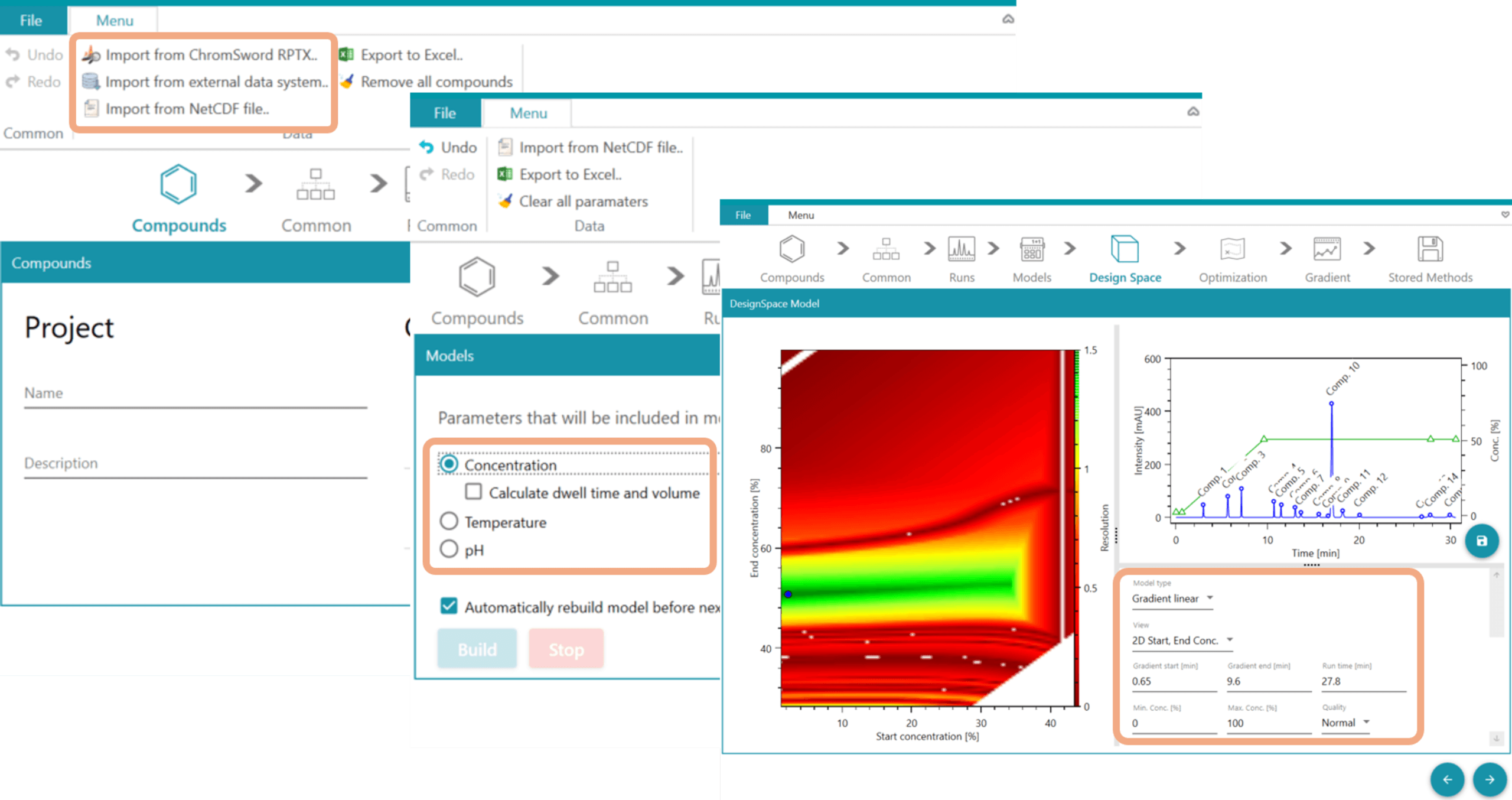
A clear workflow from data to model
Data input is simple
- Choose the data to input
- Use the data
- Select the optimization model
Model concentration before the run
Optimize gradient
ChromSword has the unique linear and multi-step optimization of gradient methods using a super-fast Monte-Carlo method.
Model ionizable compounds
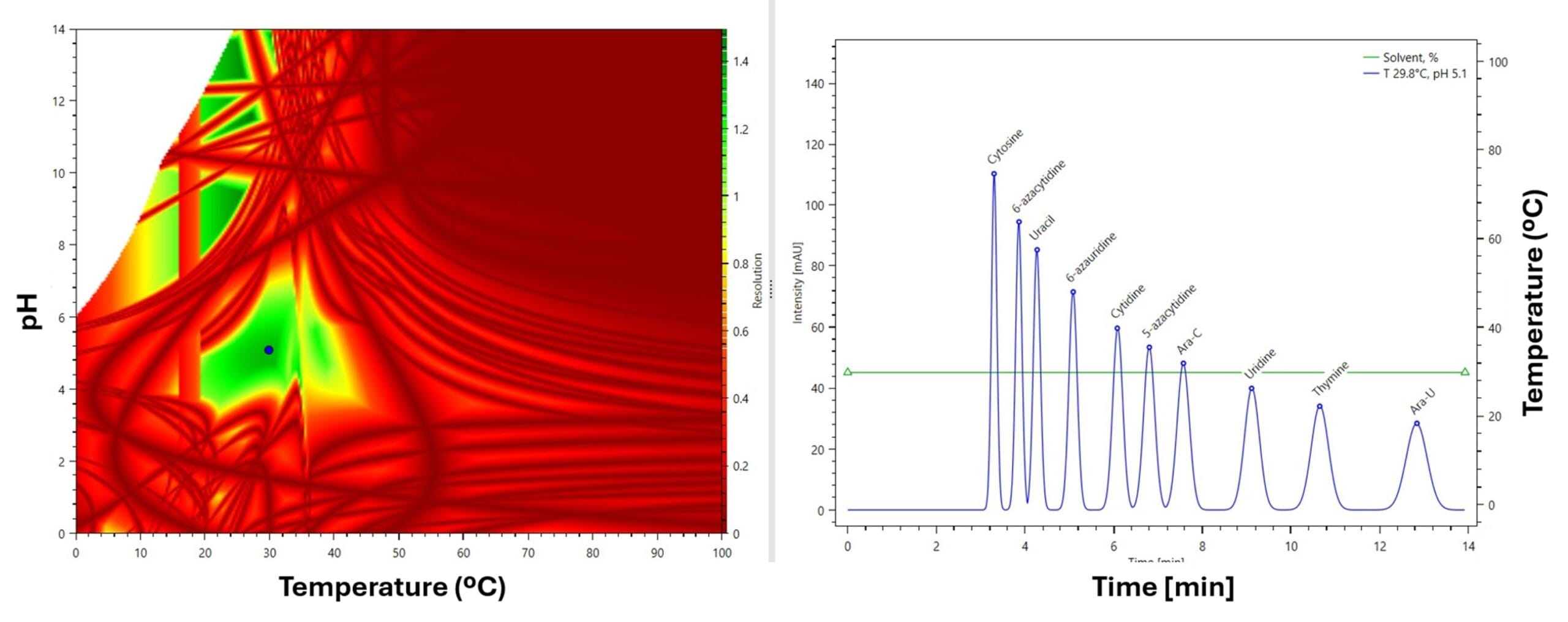
Optimize temperature and pH
When the sample contains basic or acid compounds with ionizable chemical groups, pH and temperature are very effective parameters for optimizing the separation. ChromSword is capable to predict molecule retention behaviour based on input runs with variable temperature and pH. System supports polynomial peak retention behaviour models that determines molecule pKa values for a very precise separation profiles.
Begin with molecular structure
Predictions based only on structural formula
The unique ChromSword approach lets the user to start the simulation without experimental data by inputting structural formulas of analytes and applying the Solvatic retention model:
ln k’ = a V2/3 + b ΔG + c
where V is the molecular volume of a solute, ΔG is the energy of interaction of a solute with water, a, b and c are the parameters which are determined by the characteristics of a reversed phase column in the eluent being used.

A ChromSword-specific approach
This is a new concept and ChromSword’s unique software that supports it
With this approach, you work more precisely and rapidly than that based on formal linear and quadratic polynomial models but it requires that both the parameters of the solutes (volume and energy of interaction with water) and the characteristics of the reversed-phase column under experimental conditions be known.
HPLCMD subscription access